
LuLu Hypermarket Greater Noida: What Its 15-Year Lease Really Means for the City
Date - 25 Oct 2026
Quick overview
LuLu’s 15-year lease at I-Thums Galleria is more than a new store opening. We unpack the rent, location, retail signal and what buyers should check before treating it as an investment trigger.
Jump to sectionsOpen
You may have seen the headline: LuLu International has taken more than 62,000 sq. ft. of retail space in Greater Noida for 15 years.
At first glance, it sounds like a straightforward retail update. A global brand has opened a large hypermarket, a landlord has found an anchor tenant, and shoppers have gained another place to buy groceries, electronics and household products.
But pause for a moment. A 15-year registered lease is not the same as a brand testing a temporary outlet. It is a long operating commitment, backed by rent, fit-out costs, staffing, inventory and a serious belief that the surrounding catchment can support a large-format store.
So, what exactly has LuLu committed to? Why was I-Thums Galleria in Alpha II chosen? Does the deal improve the case for Greater Noida property, or is that conclusion being stretched too far?
Let us separate the confirmed facts from the excitement.
Quick overview
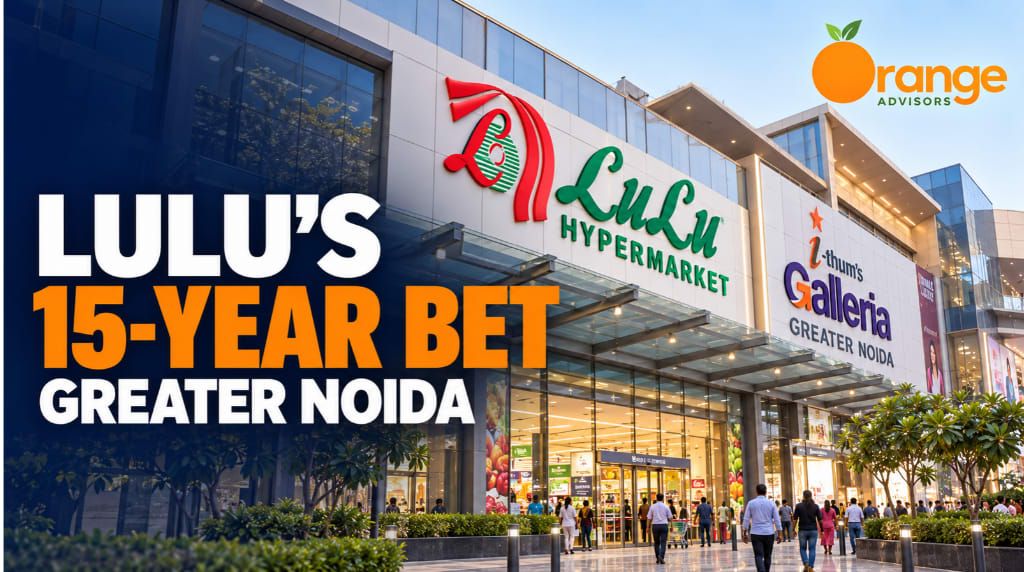
LuLu International Shopping Malls Private Limited has leased approximately 62,035 sq. ft. of carpet area on the lower-ground floor of I-Thums Galleria, Sector Alpha II, Greater Noida. The lease is for 15 years and has been executed with Adihm Developers Private Limited, according to lease data reported by Propstack and covered by ETRealty.
The leased area is divided into:
- 56,035 sq. ft. of retail carpet area
- 6,000 sq. ft. of back-of-house space
The initial rent has reportedly been set at ₹45 per sq. ft. per month for the retail portion and ₹20 per sq. ft. per month for the back-of-house area. That works out to an initial monthly base rent of approximately ₹26.42 lakh.
The agreement provides for a 9% rent escalation every three years. ETRealty calculates the scheduled base rent across the full 15-year tenure at about ₹56.9 crore, excluding maintenance, taxes and other operating costs. Some other reports describe the rent commitment as nearly ₹51 crore. The variation appears to come from how the rent commencement and fit-out period are treated, so readers should not mix the two figures without checking the underlying lease assumptions.
The tenant has an initial three-year lock-in, while the landlord is reportedly locked in for the entire 15-year term. Other reported terms include a security deposit of roughly ₹1.585 crore, 10 car-parking spaces and 100 two-wheeler spaces.
The store has been described by LuLu as an approximately one-lakh-sq.-ft. hypermarket. That does not necessarily conflict with the registered 62,035-sq.-ft. lease figure. The larger number refers to the super built-up footprint, which includes a proportionate share of common areas; the lease figure refers to carpet area.
Why this deal deserves attention
Greater Noida has had malls, high streets and neighbourhood markets for years. One more hypermarket does not suddenly create a retail market.
What makes this transaction worth studying is the combination of three things: the tenant, the size and the duration.
LuLu is not entering with a small convenience format. It is operating a large hypermarket that needs repeat spending from a broad customer base. The format depends less on occasional destination shopping and more on regular household demand: groceries, fresh food, packaged products, electronics, home appliances and daily essentials.
Then there is the 15-year tenure. Long leases require both sides to think beyond the launch period. The retailer must believe the catchment can support operations over multiple economic cycles. The landlord, meanwhile, accepts a structured escalation schedule rather than chasing a new tenant every few years.
This does not guarantee commercial success. Retail performance ultimately depends on footfall, sales density, parking, access, tenant mix and day-to-day mall management. Still, the lease gives us a stronger signal than a marketing announcement or a memorandum of understanding. A registered lease with a defined rent schedule creates a real financial commitment.
Understanding the rent: the headline number is only the beginning
The initial monthly base rent of about ₹26.42 lakh translates to roughly ₹3.17 crore a year before escalation. Reported common-area maintenance charges are approximately ₹12.11 lakh per month, separate from the base rent.
That difference matters. When people assess commercial property, they often focus on the rent printed in a headline and ignore the operating structure behind it. A large retailer does not evaluate a location using base rent alone. It looks at the complete occupancy cost, including maintenance, power, fit-out, logistics, staffing and the revenue the store must generate to remain viable.
The 9% escalation every three years is also more measured than an aggressive annual increase. For the landlord, it creates predictable growth. For the tenant, it makes long-term occupancy costs easier to plan.
If you are evaluating a retail unit because a major anchor has arrived, do not apply LuLu’s lease rate directly to every shop in the building. A 56,035-sq.-ft. anchor space on a lower-ground floor is negotiated very differently from a 300-sq.-ft. ground-floor shop. Area, frontage, floor, visibility, lease structure, fit-out contribution and the brand’s ability to generate footfall all influence the final rate.
This is the same reason we urge investors to look beyond advertised yields in our guide to the hidden mathematics of commercial real estate on the Noida Expressway. A famous tenant can improve an asset’s profile, but it does not make every unit equally valuable.
Why I-Thums Galleria and Alpha II make sense
I-Thums Galleria is located in Alpha II, opposite the Delta 1 station on the Noida Metro Aqua Line. It sits near established Greater Noida sectors rather than depending entirely on a future population that has yet to arrive.
That distinction is important for a grocery-led anchor. Hypermarkets need repeat customers within a practical travel radius. Residents may drive across the city for a movie or a special dinner, but weekly shopping usually follows convenience.
The project’s official website describes I-Thums Galleria as an operational mixed-use commercial destination with retail, restaurants, offices, a hotel, a cinema and entertainment space. It also highlights access to the Noida-Greater Noida Expressway and the Yamuna Expressway, as well as proximity to Pari Chowk, Knowledge Park, institutional areas and major employment zones.
The strongest part of the location story is not a future airport timeline. It is the existing urban catchment around Alpha, Beta, Gamma, Delta, Pari Chowk, Knowledge Park and nearby residential communities.
That is also why the established Greater Noida belt should be analysed separately from Greater Noida West and the newer Yamuna Expressway sectors. Our comparison of Noida Extension and the Pari Chowk side of Greater Noida explains this maturity difference in more detail. The Pari Chowk–Alpha–Delta side already has metro access, institutions, offices, housing and daily-use infrastructure working together.
What LuLu’s entry says about Greater Noida’s retail market
The most useful conclusion is also the least dramatic: organised retailers are becoming more confident that Greater Noida has enough population density and spending power to support larger formats.
For a long time, Greater Noida’s real-estate story was dominated by land availability, planned roads, educational institutions and manufacturing. Lifestyle infrastructure developed more unevenly. Some pockets had strong residential occupancy but limited organised retail, while some commercial projects promised footfall long before the surrounding catchment was ready.
That gap is gradually narrowing.
LuLu is not the only international retailer looking at the wider region. Carrefour has also returned to India through a partnership model and opened a large-format store in Greater Noida West. Meanwhile, developers are planning additional malls and mixed-use destinations across Noida and Greater Noida.
These moves suggest that brands increasingly see the region as several distinct consumer markets rather than one distant suburb of Delhi. Greater Noida West has its own dense residential catchment. Central Greater Noida has mature sectors, institutions and industrial employment. The Noida Expressway has premium housing and corporate demand. The Yamuna corridor is building a newer aviation- and industry-led ecosystem.
If you are trying to understand how these submarkets differ, our detailed guide to Noida vs Greater Noida vs Yamuna Expressway provides the broader context.
What does this mean for residents?
For residents, the first impact is practical rather than financial.
A large hypermarket expands choice. It can bring fresh produce, imported and regional products, electronics, appliances and household essentials under one roof. It also increases competition among supermarkets and local retailers, which can improve selection, service and promotional pricing.
The store may also change how frequently people visit I-Thums Galleria. Cinemas and restaurants often create evening or weekend traffic. A hypermarket adds repeat weekday visits and routine household trips. That can support cafés, food outlets, services and smaller retailers in the same complex, provided circulation and mall operations are managed well.
Residents should still judge the experience after the initial launch period. Opening-week crowds are not the same as sustainable footfall. Parking queues, entry and exit movement, stock availability, billing time and the quality of the surrounding tenant mix will determine whether the hypermarket becomes a regular destination.
What does it mean for commercial-property investors?
This is where the conversation needs restraint.
An anchor tenant can improve a mall’s credibility. It can make the project easier to explain to shoppers, attract complementary brands and create more consistent visits. For existing owners at I-Thums Galleria, LuLu’s long lease is a positive operating development.
But it does not automatically justify a price increase in every available shop or office.
If someone offers you a commercial unit using “LuLu has arrived” as the entire investment case, ask five questions:
- Is the unit already leased? An anchor tenant elsewhere in the mall is different from a lease on your specific unit.
- What is the actual carpet area? Returns calculated on super area can look better than the usable space warrants.
- What is the all-inclusive occupancy cost for the tenant? Maintenance and taxes can affect how much rent a smaller retailer can sustainably pay.
- Is the return guaranteed by contract or merely projected? A brochure yield is not the same as a registered lease with rent being received.
- How liquid is the unit? Small commercial properties can take longer to resell, especially when the asking price assumes future footfall.
Also check the sanctioned use, occupancy certificate, RERA registration where applicable, title, existing encumbrances, maintenance agreement and the exact location of the unit within the project.
The LuLu lease is meaningful evidence about the mall’s anchor strategy. It is not a substitute for unit-level due diligence.
Does this strengthen residential real estate nearby?
Yes, but in a supporting role.
Homebuyers value access to groceries, healthcare, schools, public transport and leisure. When organised retail improves, an area becomes easier to live in. That can strengthen end-user demand, especially in established sectors where buyers are comparing everyday convenience rather than distant infrastructure promises.
However, one hypermarket does not determine residential prices. Property values are shaped by the quality of the project, developer track record, supply, connectivity, employment access, neighbourhood upkeep and the entry price paid by the buyer.
For someone considering Greater Noida today, LuLu’s entry is another piece of evidence that the city’s lifestyle ecosystem is becoming deeper. It should sit alongside the metro, expressways, education and employment base in your analysis.
You can browse verified residential options in Greater Noida to compare how established central sectors differ from newer launches. Buyers tracking the city’s next wave can also read our analysis of Hero Homes’ Greater Noida and Yamuna Expressway expansion.
The wider LuLu plan matters more than one store
Company executives have reportedly said that LuLu plans to invest around ₹2,500 crore and establish 25 outlets across Delhi-NCR by 2030. The proposed network could include large hypermarkets as well as smaller daily-use formats, depending on local population and available space.
If that plan progresses, the Greater Noida outlet will look less like a one-off experiment and more like the first part of a regional distribution and retail strategy.
That regional approach makes sense. LuLu already has experience in Uttar Pradesh through Lucknow and has previously announced a food and agricultural processing investment in Greater Noida. Retail expansion across NCR could allow the group to build supply-chain efficiency while serving different catchments through different store sizes.
Still, the 25-outlet plan is a forward-looking target. Investors should track signed leases, operational openings and capital deployment rather than assuming every proposed outlet will arrive on schedule.
This distinction between announced interest and deployed capital is central to our analysis of foreign investment across Noida, Greater Noida and the YEIDA-Jewar corridor. A plan is a signal; an operating asset or registered lease is stronger evidence.
What this deal does not prove
The LuLu lease does not prove that every Greater Noida mall will succeed. It does not establish that all nearby commercial units are undervalued. It does not guarantee a particular rental yield, resale price or appreciation rate.
Retail assets are extremely sensitive to execution. Two buildings on the same road can perform very differently because of entry design, parking, visibility, tenant mix and management quality.
The deal also should not be used to claim that online commerce is losing relevance. Large physical retailers now compete through experience, fresh categories, immediate product access and omnichannel fulfilment. The winning locations are likely to be those that combine strong catchments with convenient access and professional operations.
In other words, the headline is encouraging, but the investment conclusion depends on the specific property in front of you.
What should buyers and investors watch next?
Over the next 12 to 24 months, five indicators will tell us whether the store is creating durable value:
- Sustained weekday and weekend footfall after the opening period
- Additional national or international brands becoming operational in the mall
- Stable occupancy and fewer dark or vacant retail units
- Traffic, parking and access remaining manageable as visits rise
- Actual shop leases being signed at sustainable rates rather than speculative asking prices
For the wider market, watch whether LuLu signs more NCR locations and whether other large retailers follow with long-duration commitments in central Greater Noida.
Final view: a real vote of confidence, not a shortcut to investment
LuLu’s 15-year lease at I-Thums Galleria is a credible positive signal for Greater Noida. The scale is substantial, the commitment is long, and the location is supported by an established residential and institutional catchment.
For residents, it improves everyday retail choice. For I-Thums Galleria, it adds a major repeat-visit anchor. For the city, it shows that international retailers are taking Greater Noida’s consumer base more seriously.
For property investors, the correct response is interest followed by due diligence. Do not buy a unit solely because a famous brand has entered the building. Study the unit, lease, carpet area, visibility, maintenance cost, legal documents and realistic exit options.
If you are evaluating a residential or commercial opportunity in Greater Noida and want to understand whether this retail expansion genuinely strengthens your shortlisted location, speak with Orange Advisors. We can help you compare the catchment, current pricing, verified leases and project fundamentals before you commit capital.
Call or WhatsApp Orange Advisors at +91 92116 99200 for a transparent, project-specific consultation.
Frequently asked questions
Where has LuLu opened in Greater Noida?
LuLu has opened a hypermarket at I-Thums Galleria in Sector Alpha II, Greater Noida, opposite the Delta 1 station on the Aqua Line.
How much space has LuLu leased at I-Thums Galleria?
The registered lease reportedly covers 62,035 sq. ft. of carpet area, including 56,035 sq. ft. of retail space and 6,000 sq. ft. of back-of-house space. The approximately one-lakh-sq.-ft. figure publicised for the hypermarket refers to the larger super built-up area.
What is the lease duration?
The lease tenure is 15 years. The tenant reportedly has an initial three-year lock-in, while the landlord is locked in for the full term.
How much rent will LuLu pay?
The initial monthly base rent is reported at approximately ₹26.42 lakh, with a 9% increase every three years. ETRealty calculates the full scheduled base rent at around ₹56.9 crore over 15 years, excluding maintenance, taxes and other costs. Other reports quote nearly ₹51 crore based on a different treatment of the rent period.
Will the LuLu Hypermarket increase nearby property prices?
It can improve the area’s convenience and strengthen the mall’s retail profile, but it cannot determine property prices by itself. Project quality, supply, connectivity, employment, entry price and unit-level fundamentals remain more important.
Is I-Thums Galleria a good commercial investment?
The LuLu lease is a positive anchor development, but each unit should be assessed separately. Verify the actual lease, carpet area, location within the mall, maintenance costs, approvals, title and resale liquidity before investing.
Sources
- ETRealty: LuLu International leases 62,035 sq. ft. retail space in Greater Noida for 15 years
- Hindustan Times: LuLu leases hypermarket space at Greater Noida mall
- I-Thum World: I-Thums Galleria project and location details
Information is based on public reports and project disclosures available as of 25 October 2026. Lease figures reported by different publications vary according to the calculation method and stated rent period. Readers should verify registered documents and current commercial terms before making an investment decision.
Ask Orange Advisors
Still have a real estate question?
Get clarity before you make your next property decision. Share your question with Orange Advisors.
More Blogs
View all25 Oct 2026
UPEIDA Industrial Plot Scheme 2026: Eight Clusters, Rates and the Real Investment Test
7 Oct 2026
Hero Sector MU Greater Noida: 3 BHK Price, Sizes & Honest Review
28 Sept 2026
Supertech's 16 Stalled Projects Finally Have a Restart Date. Here's What It Actually Means for You
26 Sept 2026
YEIDA Rolls Out 20 Plots for Housing and Hotels Near Noida Airport